
Winter capsule wardrobe: how many warm layers you need
Build a winter capsule wardrobe from what you own: how many tops, knits, trousers and coats a week needs, worked out from how often you do the laundry.

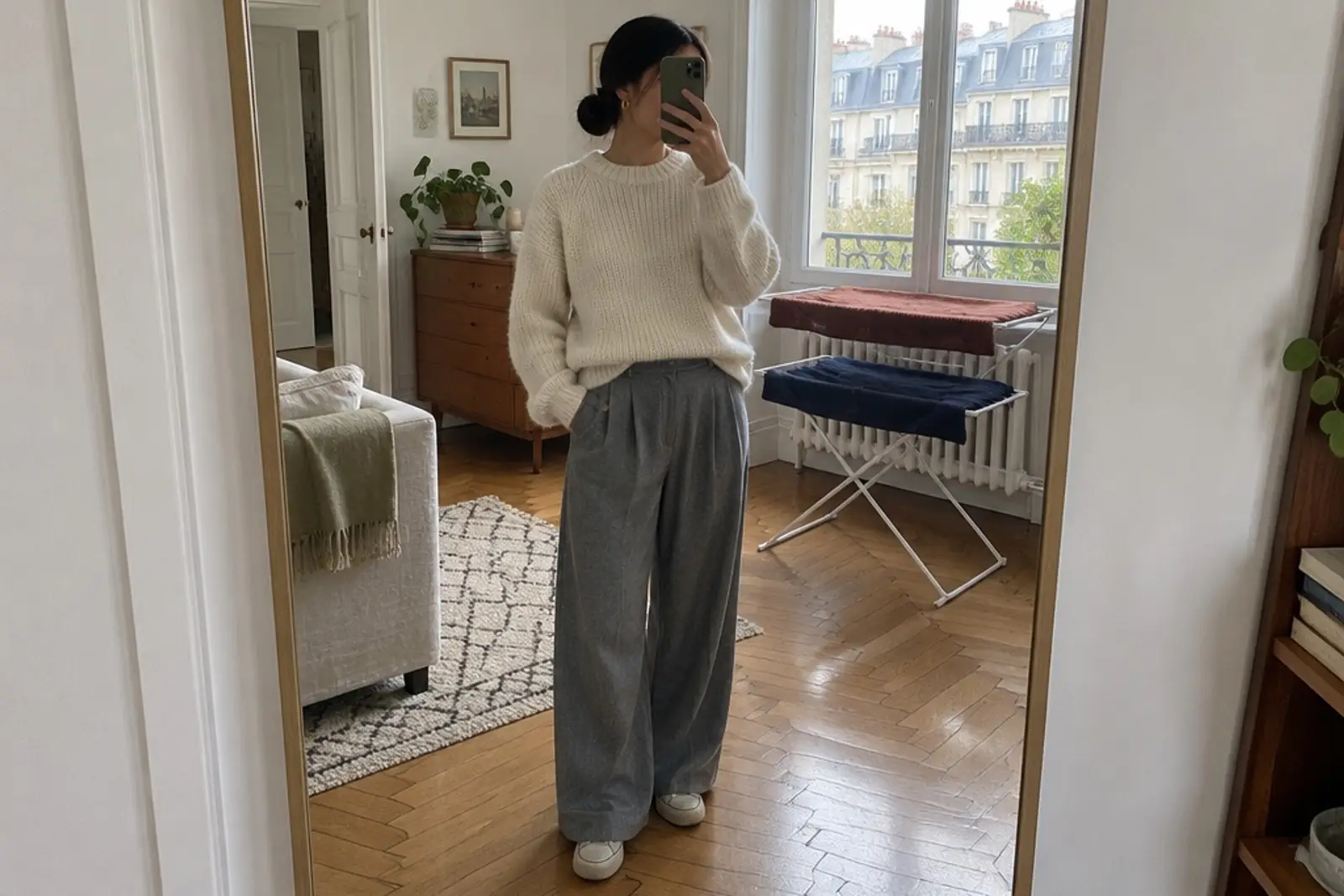
For a week of winter with one laundry day, most people need about 7 tops, 2 or 3 knits, 2 or 3 bottoms, 1 coat and 2 pairs of shoes, plus a hat, scarf and gloves. That’s around 14 to 16 main pieces, and you may own them already. The count depends mostly on how often you wash, so here’s how to work out your own.
If you’re new to the idea, start with our guide to building a capsule wardrobe. This post covers only the winter numbers.
How to work out your winter numbers
The sum is short:
Days between laundry ÷ wears per wash = how many you need. Round up.
The wears per wash come from Utah State University Extension, citing the American Cleaning Institute. T-shirts, undershirts, leggings, socks and underwear go in the wash after each wear. Sweaters, slacks, jeans, dresses and skirts last 3 or 4 wears. Heavy coats need washing only once or twice a year.
These are guidelines. A sweater worn over a shirt to a desk job will last longer than one worn on a crowded commute, and the clothing care guide has more on washing less often. Shirts aren’t on the list, so we’d treat them like T-shirts unless you only wear them for a short time. Thermal tops aren’t on the list either, but they’re worn against the skin, so we’d treat them the same way.
How many of each you need
Here’s that sum worked out for three laundry habits. We’ve calculated this table ourselves from the wash guidance above. It assumes that you wear a clean top every day, with a knit and a bottom over several days.
| Laundry every | Tops worn next to the skin | Knits | Trousers, jeans or skirts | Coat |
|---|---|---|---|---|
| 7 days | 7 | 2 or 3 | 2 or 3 | 1 |
| 10 days | 10 | 3 or 4 | 3 or 4 | 1 |
| 14 days | 14 | 4 or 5 | 4 or 5 | 1 |
The range comes from the two figures in the guidance. For 7 days, 7 ÷ 4 rounds up to 2, and 7 ÷ 3 rounds up to 3.

Three things can bring the numbers down:
- Tops are the biggest group, and the easiest to cut. If you work from home two days a week, or run a small wash midweek, you may need only 4 or 5.
- Dresses count twice. A knit dress can replace both a top and a bottom on the days you wear it.
- Not every day needs a knit. If your home or office is warm, a shirt may be enough indoors.
We’d also keep one more knit than the sum says if you hand-wash or dry flat, because a knit may not be dry for the next day.
How many outfits that gives you
With 3 knits and 3 bottoms, you get 3 × 3 = 9 combinations before you even change the top underneath. That’s more than a week’s worth. With 2 knits and 2 bottoms, you get 4, which is enough if you don’t mind repeating.

This only works if the pieces go together. If one knit clashes with two of your trousers, count the pairs that you’d actually wear. Our guide to colour combinations that work can help you choose.
Sample capsules from the same numbers
These two examples use the 7-day row. They’re our suggestions, not a shopping list, so swap in whatever you already own.
| Group | A women’s capsule | A men’s capsule |
|---|---|---|
| Tops | 4 long-sleeved tops, 2 shirts, 1 thermal | 4 T-shirts or long-sleeved tops, 2 shirts, 1 thermal |
| Knits | Fine roll neck, cardigan, chunky jumper | Fine crew neck, zip knit, chunky jumper |
| Bottoms | Dark jeans, smart trousers, wool skirt with tights | Dark jeans, chinos, wool trousers |
| Coat | Warm wool or padded coat | Warm wool or padded coat |
| Shoes | Waterproof boots, loafers or low boots | Waterproof boots, leather shoes |
| Extras | Hat, scarf, gloves or mittens | Hat, scarf, gloves or mittens |
Tights count as next-to-skin washing, so they sit outside the sum, along with socks and underwear.
Adjust for how cold your winter gets
The number of pieces depends on your laundry. What they’re made of depends on your weather. These bands are our own rough guide, so go by how you feel in the cold.
| Your winter | What changes |
|---|---|
| Mild and wet | Fine knits and a waterproof layer matter more than a heavy coat |
| Cold, often below freezing | A warm coat, a thermal or two for long days outside, and boots with grip |
| Very cold | Thermals become normal, plus a hood, a hat and mittens |

For real cold, the National Weather Service recommends several loose, lightweight, warm layers rather than one heavy piece, because air trapped between them insulates you. It says that outer garments should be tightly woven, water repellent and hooded, and that mittens snug at the wrist are better than gloves.
It also suggests avoiding cotton for strenuous outdoor activity, because wet cotton dries slowly and pulls heat from your body. A cotton T-shirt under a knit is fine for an office. For a long winter walk or shovelling snow, a wicking layer is safer. Extreme cold is a safety issue as well as a style one, so follow local weather advice before any style guide.
Our layering guide covers the three layers in more detail.
How to build it from your own clothes
- Get your winter clothes out. Our guide to the seasonal wardrobe switch covers sorting, repairs and what to keep out.
- Choose your row. Decide how often you really do laundry, not how often you’d like to.
- Count what you already wear. Include only what fits and what you’ve reached for lately. Our capsule wardrobe checklist can help you keep track.
- Compare with the table. Having more than the table says is fine. Put your favourites at the front and store the rest for a few weeks.
- Live with it for two weeks. Note any day when you were short of something.
If you’re really short of something, such as a warm coat, it’s worth buying for that gap alone. This also fits with a No Buy November, where a real need can go on your list without breaking the rules.
See what you actually wear
The table assumes that you wear a different combination each day, but most of us have favourites. Keep a note of what you wear for two weeks, and you’ll have your own numbers. That’s what we’d like Amalook to make easier once it’s out, by showing what you really reach for. For now, a note on your phone works just as well.
Common questions
How many items should a winter capsule wardrobe have?
There's no fixed number. If you do laundry once a week, about 7 tops, 2 or 3 knits, 2 or 3 bottoms, 1 coat and 2 pairs of shoes will cover the week, not counting underwear and socks. That's roughly 14 to 16 pieces plus a hat, scarf and gloves.
How many sweaters do you need for winter?
If you wash a sweater every 3 or 4 wears and do laundry weekly, 2 or 3 are enough for one sweater a day. Three give you more variety and more time for one to dry.
Do you need to buy anything for a winter capsule?
Often not. Count what you own against the table first. If you're short of something, buy for that gap alone, and only what would stop you getting through a normal week.
Does a winter capsule work for men, or at any age or size?
Yes. The numbers come from how often you wash your clothes and how cold it gets, not from your age, size or gender. Swap in the pieces you like to wear.
Sources
Checked on 5 November 2026. Listings change, so check them again before you decide.