Does seasonal colour analysis work? What the studies show
Seasonal colour analysis has barely been tested. We read the research on the four seasons, what it supports, what it doesn't and how to check colours yourself.
Seasonal colour analysis hasn’t been shown to work as advertised. We found no study showing that sorting people into four or twelve seasons predicts which colours look best on them. There is some evidence that colouring affects which clothes people think suit a face, but it’s narrow, and it doesn’t confirm the seasons.
That doesn’t make a colour session worthless. It means the session is closer to expert opinion than to a test result. Here’s what has been studied, what hasn’t, and how to check a palette for yourself.
Where the four seasons came from
The method is younger and more commercial than it sounds. A 2021 paper by David Perrett and Reiner Sprengelmeyer at the University of St Andrews traces stylists’ advice back to the colour contrasts described by the art teacher Johannes Itten. Pair warm with cool and bright with muted, and you get four groups. The authors describe the season names given to those groups as arbitrary.
Itten’s The Art of Color came out in 1961. It was a book about art, not a guide to getting dressed. The idea reached a mass audience through consultants and popular books, above all Carole Jackson’s Color Me Beautiful in 1980. Later systems split the four seasons into twelve or more.
What has been tested
Not much. The St Andrews authors wrote that stylists’ advice had never been systematically studied, and they reviewed the few earlier attempts. We haven’t read those older papers directly, so the first three rows below rely on that review.
| Study | What it did | What it found |
|---|---|---|
| Collin, 1986 | Compared recommendations from 11 colour stylists | Little consistency, beyond a loose tendency to give cool colours to “cool” seasons and warm to “warm” |
| Francis and Evans, 1988 | Showed eight garments on one model classed as a Spring | Ratings didn’t support the advice. Lightness of the colour seemed to matter, not hue |
| Radeloff, 1990 | Compared colours recommended and not recommended for each season | Recommended colours were picked more often, but the design couldn’t rule out that some colours are simply less popular |
| Cassidy, 2007 | Examined existing personal colour systems | All claimed to use hue, saturation and value, but these were rarely applied across their palette types |
| Perrett and Sprengelmeyer, 2021 | 96 and 75 online observers chose clothing colours for 12 faces of White women | Blues favoured for fair skin, oranges and reds for tanned skin |
| Perrett, 2023 | Altered skin tone in face images and swapped eyes between them | Eye colour had the dominant influence. Skin colour had little |
We looked for a modern study that tests whether analysts agree on the same person, or whether wearing “your” season makes people look better to others. We didn’t find one. That isn’t proof that none exists, but it’s a telling gap for a method this popular.
Why the system is hard to test
The categories are wide. The 2021 paper points out that Jackson’s Winter covers skin described as anything from grey-beige to sallow to milky white, and that the same skin descriptions turn up in more than one season. Two people who look nothing alike can end up in one category.
The reasoning can go in a circle. Some tests decide you have a warm undertone because warm colours look good on you, then advise warm colours because you have a warm undertone. That isn’t a finding. It’s the starting assumption repeated.
Agreement isn’t accuracy. Analysts trained in one system may well agree with each other. As the St Andrews authors note, consistency doesn’t show the system is valid. An app trained on faces already sorted by stylists has the same problem: it can copy the sorting without showing that the sorting means anything.
What the research does support
Two findings are worth keeping, with their limits attached.
The first is that people aren’t random about this. In the 2021 experiments, observers repeatedly chose similar colours for the same faces, across two separate groups and two tasks. So a sense of “that suits her” is at least partly shared.
The second is the broad warm and cool idea, which held up better than the seasons themselves. Blues were favoured for fair skin and oranges and reds for tanned skin, which roughly matches what stylists say.
Then the limits. The faces in that study were all young White women, and there were only twelve. The authors say they don’t know whether the result extends to other ages, genders or ethnic backgrounds. They also note that the link between melanin and skin yellowness reverses in darker skin, so the pattern can’t simply be assumed there. That matters, given how often these systems are sold as universal.
The 2023 study complicates things further. When skin tone and eyes were changed separately, eye colour drove the choices, even when people were asked to match the clothes to skin. If that holds up, a method built mostly around skin undertone may be looking in the wrong place.
How to check a palette yourself
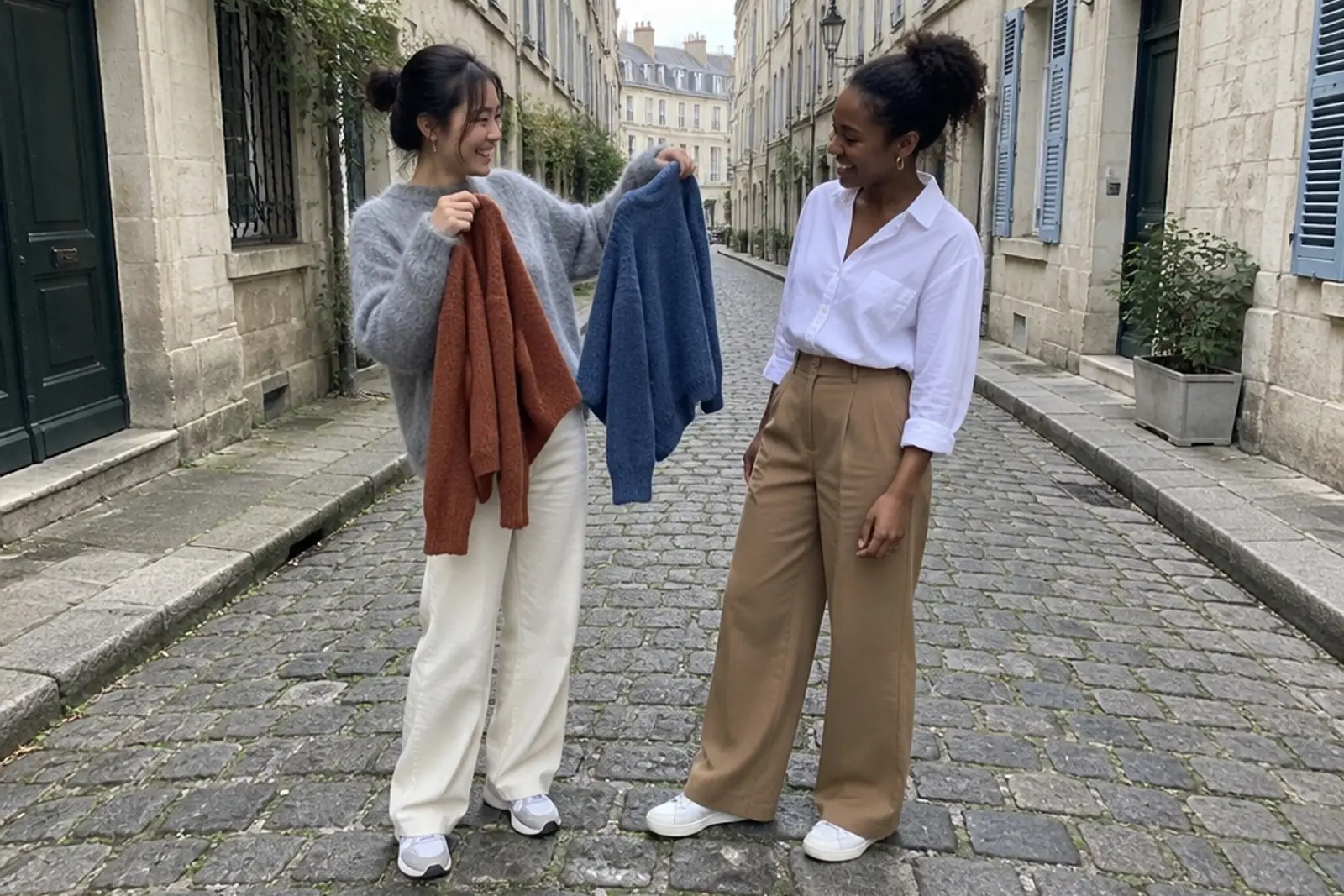
The 2021 paper describes what a fair test would need: the same two colours, tried on different people. You can run a small version at home. It isn’t science, but it’s better than taking a palette on trust.
- Pick pairs. Choose two tops or scarves that differ in one way only, such as warm and cool red, or light and dark blue.
- Use daylight. Stand by a window with no makeup or the same makeup each time, and take a photo in each colour.
- Compare later. Look at the photos side by side an hour later, or ask a friend which looks better without telling them what your season is meant to be.
- Repeat with your “wrong” colours. Try at least one colour your palette rules out. If it wins, believe the photo.
- Check your own history. Look through photos where you like how you look. Our guide to finding your undertone has more on holding colours near your face.
Keep what wins, and don’t worry if the results cross seasons. Your favourite colours can still go in trousers, shoes and bags, away from your face. These colour combinations work whatever season you’ve been given.
Is it worth paying for an analysis?
It depends on what you want from it. A good analyst gives you an hour of focused attention, a lot of fabric held near your face and a vocabulary for what you’re seeing. Plenty of people enjoy that, and it can get you out of a rut.
It’s less useful if you treat it as a diagnosis. There’s no standard qualification for colour analysts, so training varies. Before you book, ask how they decide, whether they test colours on you or sort you by a chart, and whether you’ll be told you can’t wear certain colours. An analyst who says “this is a starting point” is being more accurate than one who says “this is what you are”.
Free quizzes and photo filters add another layer of doubt, since a photo’s colours change with the light and the camera. Use them for fun.
Watching what you actually wear
The most reliable data about your colours may already be in your wardrobe. What do you reach for, and which pieces stay on the hanger? When Amalook comes out, its style insights are meant to show the colours you really wear, without assigning you a season. Until then, your camera roll will do the same job.
Common questions
Is seasonal colour analysis scientifically proven?
No. We found no study showing that sorting people into four or twelve seasons predicts which colours look best on them. A 2021 paper from the University of St Andrews said the categories aren't defined scientifically and that stylists' advice hadn't been systematically studied.
Do colour analysts agree with each other?
The evidence is thin and old. A 1986 study, as summarised in the 2021 St Andrews paper, found little consistency across 11 colour stylists' recommendations. We couldn't find a modern study that tests whether analysts place the same person in the same season.
Does skin tone affect which clothing colours look good?
Possibly, but less clearly than the seasons suggest. In one study, observers leaned towards blues for fair skin and oranges and reds for tanned skin. A later study by the same lead researcher found eye colour mattered much more than skin colour. Both used images of White women.
Is a colour analysis worth paying for?
It can be useful as a guided look at colours near your face, or simply as a fun experience. It isn't a measurement, so treat the result as a starting point and test it against your own photos.
Sources
Checked on 8 November 2026. Listings change, so check them again before you decide.
- Perrett and Sprengelmeyer: Clothing aesthetics, consistent colour choices to match fair and tanned skin tones (i-Perception, 2021)
- Perrett: Eye color is more important than skin color for clothing color aesthetics (Psychology of Aesthetics, Creativity, and the Arts, 2023)
- Cassidy: Personal colour analysis, consumer colour preferences and colour forecasting (Journal of the International Colour Association, 2007)
- Wikipedia: Color analysis (history and references)